Remote Sensing Change Detection/Feature Extraction
Change Detection
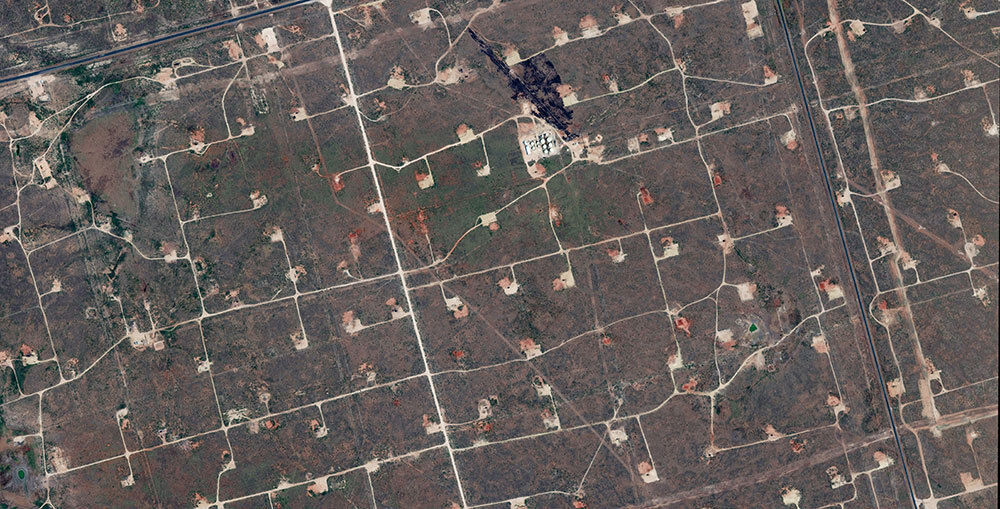
Energy companies need accurate and timely information about their worldwide assets, including facilities and disturbed land features resulting from exploration. Collecting such data through field surveys is time consuming and costly. As an alternative, Spatial Energy offers Change Detection services using temporal sequence of imagery to monitor and quantify changes of user specific features over time. High and medium resolution satellite imagery is collected and then analyzed using proprietary algorithms to identify spatial, spectral and temporal characteristics. Robust and timely maps depict land feature changes and associated statistics.
View brochure (pdf).
Change Detection Services Offered
Change detection can be used for variety of applications, such as the quantification of re-vegetation activities in disturbed areas; monitoring of facilities, movement of oil spills (land and sea), pipeline encroachment, and changes in ice/snow extent. Because imagery used in this process is ortho-rectified, Spatial Energy can customize the feature map such that it can be leveraged fits within the customer’s decision system to support production management, analysis of disturbances due to exploration activities and logistic planning.
The changed map resulting from the change detection process shows the spatial distribution of changed features within a specified area of interest. The process uses imagery collected before (baseline) and after the changes occur to help identify features from baseline imagery, monitor their condition, and identify new features of interest based on subsequent imagery. All changed features and associated statistics are provided in map formats ready for ingest in the customer’s decision support system.

Feature Extraction
Energy companies need accurate and timely information about their worldwide assets, including disturbed land features resulting from exploration. Gathering such information through field surveys is time consuming and costly. As an alternative, high and medium resolution radar and optical satellite imagery can be collected and then analyzed using proprietary algorithms to identify spatial, spectral, and temporal characteristics and to produce robust and timely land feature maps and associated statistics.
- view brochure (pdf)
Services Offered
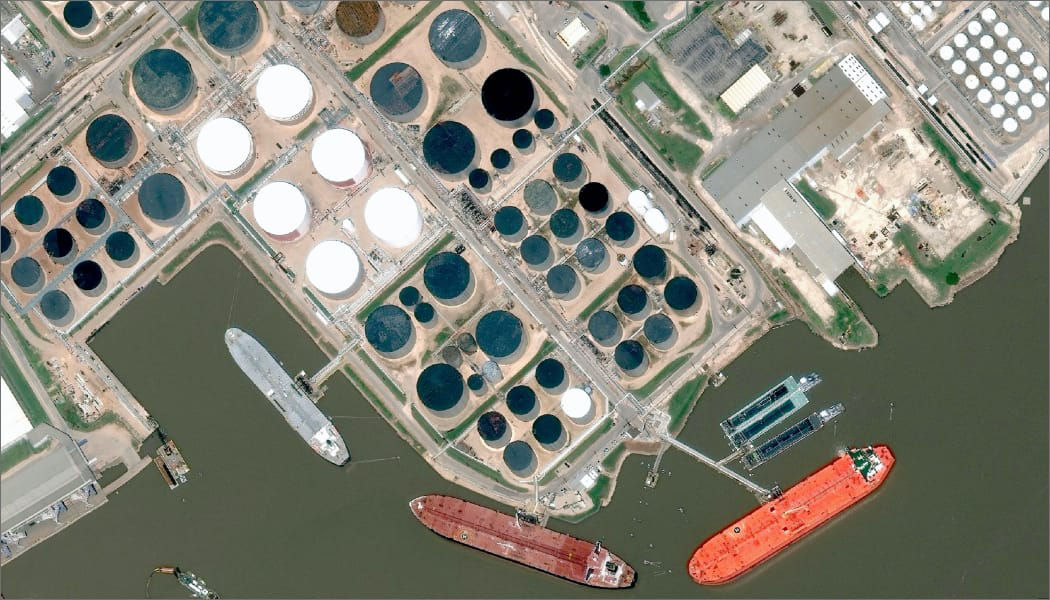
Spatial Energy’s Feature Extraction service uses state-of-the-art image segmentation and classification techniques. Features that can be extracted from imagery include facilities (e.g., building foot prints), transportation features, land use/land cover, vegetation types (e.g., agriculture, forest types), disturbed features due to exploration activities, water bodies, oil spills in water, soil types, and more. Contours, hillshades, and slope/aspect from DTM data can also be extracted.
Through feature extraction, maps are produced which depict the spatial distribution of each object of interest, the total area each object occupies, and the exact location of each object within a specified area of interest. All maps and associated statistics are provided in formats ready for ingest into decision support systems.
The imagery used for feature extraction is orthorectified which enables Spatial Energy to customize the feature map such that it fits within the customer’s decision system to support production management, analysis of disturbances due to exploration activities, and logistics planning.
Additional Information
Spatial Energy is dedicated to providing the most comprehensive suite of imagery solutions and geospatial data and image processing services for oil and gas companies operating worldwide. For additional information regarding our services, please contact us via phone or email.
|